
Global Backbone Becomes a Source of Attacks
September 6, 2025Infrastructure from Scratch: Why Building a Cloud Platform Is Not the Same as Maintaining One
There is a major difference between joining an infrastructure team that already has systems, processes, standards, and documentation — and becoming the person who has to create all of that from zero.
On paper, the titles may look the same:
Infrastructure Engineer.
DevOps Engineer.
Cloud Architect.
SRE.
But in practice, the work can be completely different
In an established company, an engineer often enters an environment where most of the foundation already exists. There are cloud accounts, CI/CD pipelines, access policies, monitoring dashboards, backup procedures, deployment rules, security standards, incident response processes, and internal documentation. The job is still complex and important, but the engineer is usually improving, maintaining, optimizing, or scaling an existing system.
In a startup or early-stage infrastructure project, the situation is very different
There may be no runbook.
No defined backup policy.
No access control model.
No monitoring standard.
No deployment workflow.
No clear security baseline.
No internal documentation.
No established architecture.
Someone has to decide how the system should exist before anyone can maintain it
That is where infrastructure engineering becomes more than tool usage. It becomes architecture, risk management, security thinking, operational design, and long-term business planning.
This is the context in which ENCRYPTIA CLOUD was created
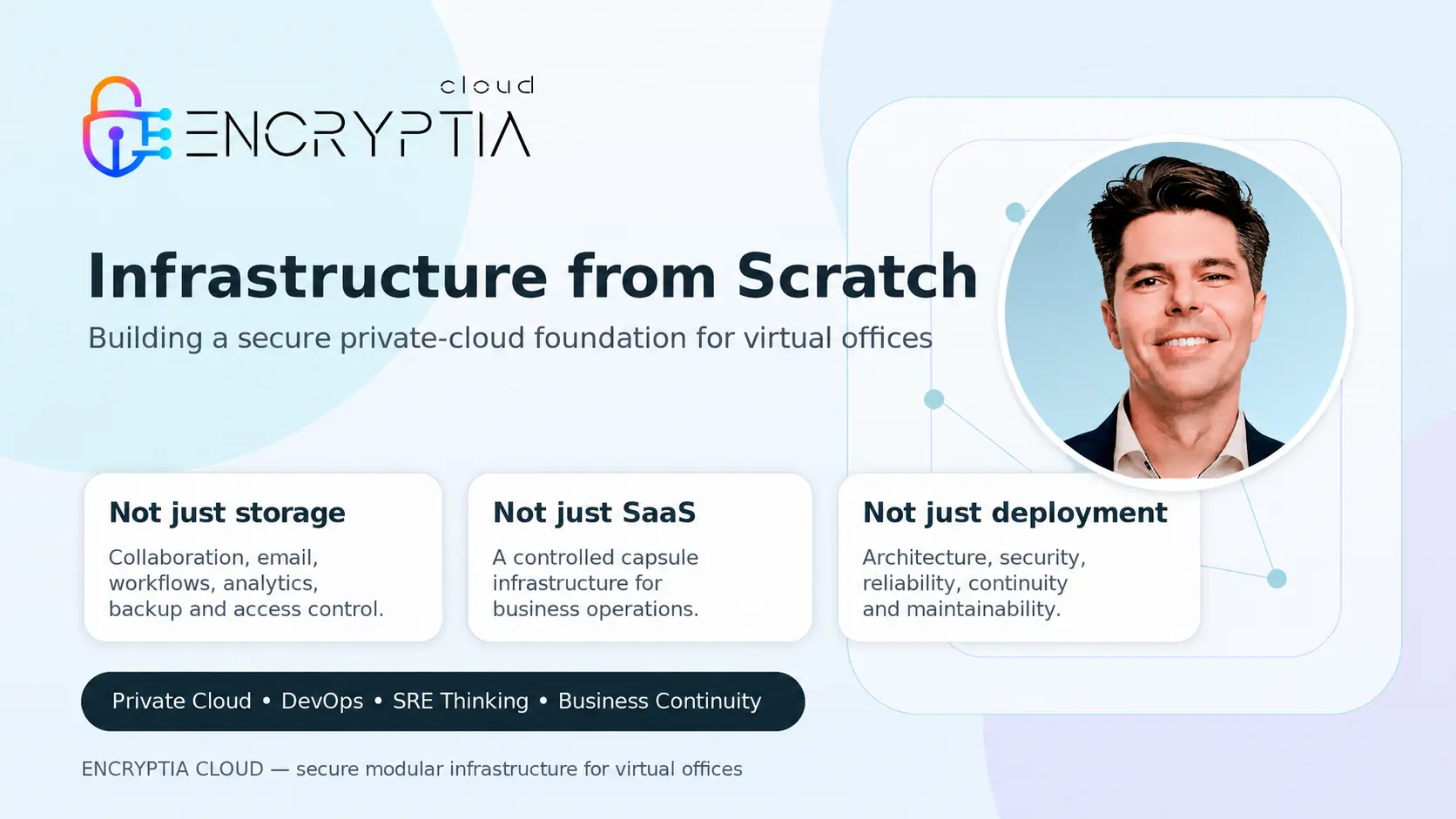
ENCRYPTIA CLOUD was not designed as just another storage product, another SaaS dashboard, or another file-sharing tool. The idea was broader: to build a secure private cloud and virtual office infrastructure that could serve as a contained, modular, business-ready environment for small, medium, and enterprise organizations.
In other words, not just “where files are stored,” but where a company’s digital operations can live.
A modern business does not need storage alone. It needs communication, collaboration, backup, access control, automation, monitoring, security, continuity, and recoverability. It needs a system where documents, email, workflows, internal tools, analytics, and operational processes can function together inside a controlled infrastructure environment.
That is the difference between a simple cloud service and a cloud infrastructure platform
When ENCRYPTIA CLOUD was being built, the challenge was not only to deploy tools. The challenge was to design an environment where multiple layers could work together:
secure storage,
business email,
collaboration tools,
workflow automation,
backup and disaster recovery,
remote access,
network security,
DNS and SSL configuration,
reverse proxy architecture,
self-hosted applications,
analytics,
API integrations,
and AI-assisted automation.
Each layer had to support the others
For example, backup is not just a technical feature. It is part of business continuity. Access control is not just a user permission setting. It is part of the security model. Monitoring is not just a dashboard. It is part of reliability and incident response. Automation is not just convenience. It reduces repetitive work, operational friction, and human error.
This is why building infrastructure from scratch requires a different mindset.
An engineer maintaining an existing system often asks:
How does this already work?
Where is the documentation?
What is the approved process?
What should I avoid breaking?
An engineer building from zero must ask different questions:
What should the architecture be?
What security model should exist?
What happens if this component fails?
How will the business recover from data loss?
How should users access the system securely?
What should be automated first?
What must be documented before the system grows?
Which decisions will create technical debt later?
How will this scale when more users, departments, or clients are added?
These are not just DevOps questions. They are infrastructure architecture questions
This is where standards-based thinking becomes important.
Security and operational standards such as ISO/IEC 17799 and the later ISO/IEC 27002 approach are valuable not because every startup can immediately become fully certified, but because they teach the correct categories of thinking: information security policy, asset management, access control, physical and environmental security, operations security, communications security, incident management, business continuity, and compliance awareness.
For an early-stage platform like ENCRYPTIA CLOUD, this kind of thinking matters from the beginning.
If security is added only after the product grows, it becomes a patch.
If backup is added only after data loss, it becomes a reaction.
If monitoring is added only after downtime, it becomes damage control.
If documentation is created only after confusion, it becomes archaeology.
Good infrastructure is not built by accident. It is designed before the failure happens.
That is what separates basic deployment from real infrastructure engineering
A person can deploy Docker containers.
A person can configure DNS.
A person can set up SSL.
A person can install self-hosted applications.
A person can connect APIs.
But building a business infrastructure platform requires connecting those actions into a system that is reliable, secure, maintainable, and understandable.
ENCRYPTIA CLOUD was created with that principle in mind
The platform concept is closer to a “capsule infrastructure” model: a controlled digital environment where a business can operate its virtual office with a private-cloud mindset. Instead of spreading business operations across many disconnected SaaS tools, the goal is to provide a more integrated infrastructure layer where storage, communication, automation, backup, analytics, and security can be managed as parts of one operational environment.
For small businesses, this means simplicity and control
For medium-sized businesses, it means structure, continuity, and room to scale.
For enterprise environments, it means the ability to think in terms of governance, access control, segmentation, monitoring, compliance readiness, and operational resilience.
This is why the role behind ENCRYPTIA CLOUD cannot be described only as administration.
It includes the work of an Infrastructure Engineer: designing and managing the technical foundation.
It includes the work of a DevOps Engineer: automating workflows, improving deployment processes, reducing manual operations, and connecting systems.
It includes the work of a Cloud Architect: making long-term decisions about structure, security, scalability, cost, and maintainability.
It also includes SRE-style thinking: asking how the system fails, how it recovers, how it is monitored, and how reliability can be improved over time.
In mature companies, these responsibilities may be divided among several teams.
In an early-stage infrastructure platform, one architect often has to think across all of them.
That is the real difference
The value is not only in knowing tools. Tools change. Platforms change. Vendors change. But the ability to design secure, reliable, business-ready infrastructure from the ground up is a deeper engineering skill.
ENCRYPTIA CLOUD was built around that idea: infrastructure should not be just a collection of services. It should be a structured digital operating environment for real businesses.
Not just cloud storage.
Not just SaaS.
Not just automation.
A secure, modular, private-cloud foundation for virtual offices, business continuity, collaboration, and operational control.